The Playbook


Sorry, I try not to talk about politics in here, but recent things have been catching my interest, and I just feel like running with them. And I know the password to this substack, so I can technically post whatever I want.
I generally think that Democrats have not been alarmist enough about things that Trump is doing. Part of the issue is that Trump’s behavior can be interpreted as a sort of DDoS attack. If there was just one thing he was doing then everyone could focus on that. But since he’s doing 10,000 different things at once, everyone focuses on a different one and no single item actually gets that much attention. There’s a lack of internal coordination on the Democratic Party in terms of what to focus on, generally speaking.
But I’ve also seen people mentioning that the Democratic Party is being too milquetoast even on the things that they do focus on. For example, I’ve seen some criticism of Cory Booker’s proposed legislation to require training and body cameras for all ICE agents.
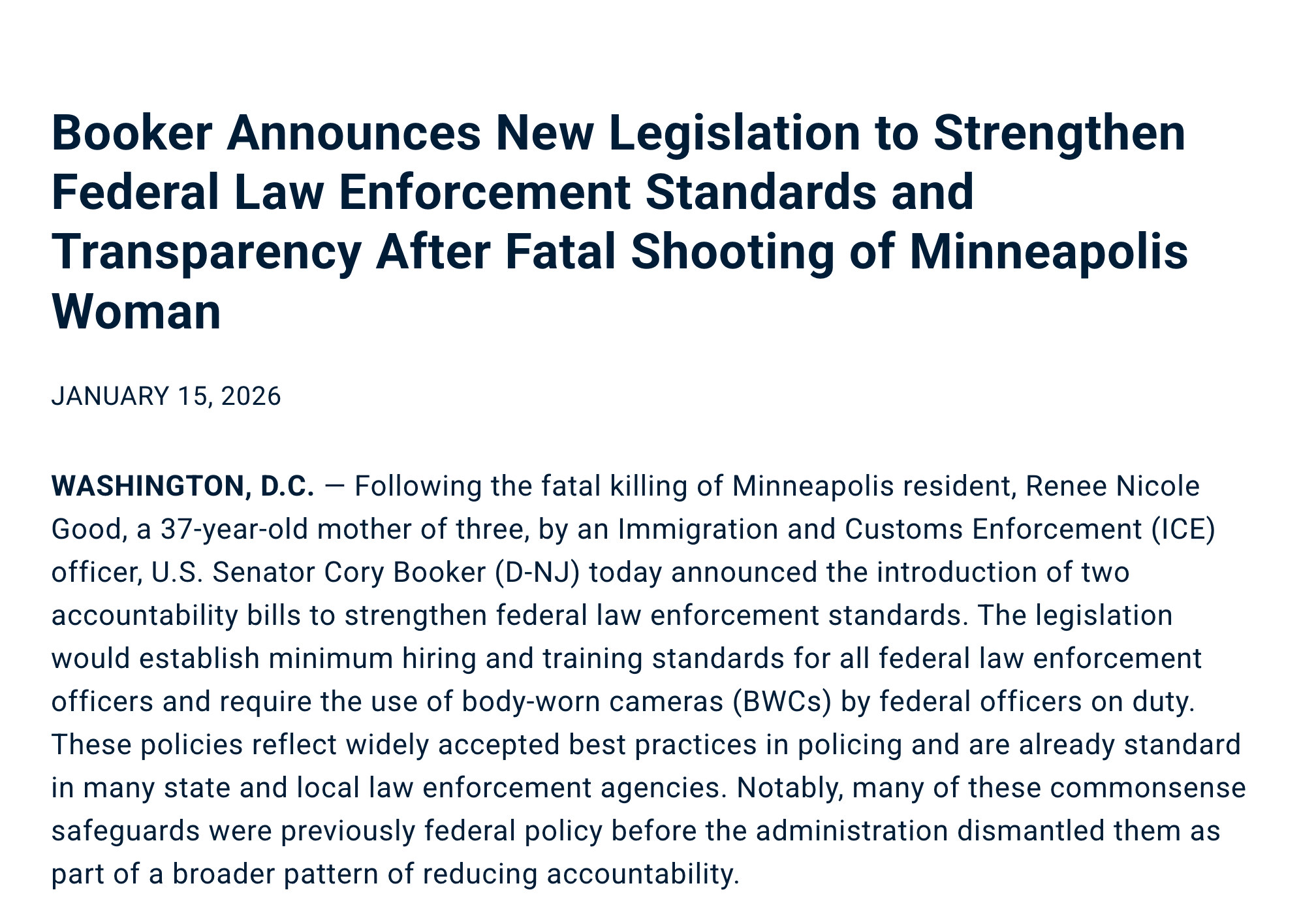
The criticism is that the lack of body cameras or the lack of training is not really the main issue. The main issue is that there’s no reason to be doing all these deportations in the first place. I fully agree with that. If I had my way the US would have dramatically more immigration. Trump has attacked both high-skill and low-skill immigration. High-skill immigrants clearly bring new fresh talent and greatly boost our economy, but even low skill immigrants unlocks domestic high-skill talent.
To understand this, imagine a society where everyone has a degree in astrophysics or nuclear engineering or whatever. In that society, they would still need people to grow food and stuff. People are going to work those jobs even if they have the skills to do something more technologically advanced. Low-skill immigration actually means that those jobs can go to the low-skill immigrants, who need and want those jobs, and frees up natives to go do more advanced work using their skills that they have. (Obviously in our society, not everyone has a degree in astrophysics. But a weaker version of the argument still applies, I think.)
However, even though I think that we obviously need much more immigration than we have, I’m not mad about Democrats for not saying this out loud. I believe that it’s not really politicians’ job to say true but unpopular things. Imagine their rhetoric on a scale, on one side talking only about optimal policy, and on the other only speaking on what is popular. In my opinion, politicians should only be 75% towards popularity and 25% towards optimal policy.
And I don’t mean that in terms of what they should morally do. Obviously if I could, I’d have all politicians advocate for what they personally believe to be the best policy regardless of popularity. But it’s a classic prisoner’s dilemma situation where, if everyone only talks about good policy with no regard for popularity, then someone can just say whatever’s popular and obliterate everyone who’s saying the correct but unpopular things. You want politicians to be far enough on the popularity scale that getting obliterated by a popularity-optimizer is not a huge risk, but not go all the way in that direction so they can still improve things somewhat.
You might say that’s a depressing view of politics, but I think it’s just how our system works. The people vote for what they like. The real responsibility lies with the media and our schooling system to correctly educate people. Hopefully by doing that, what is popular will align with what is good policy. If popularity and good policy were the same, or at least if they were very closely linked, we’d be in a much better situation.
Now, you might be thinking, “isn’t Trump an exception to this? He says ‘I want to invade Greenland’ and suddenly every Republican gets a new brain chip installed and they start repeating about how Greenland is an essential strategic asset that the US needs to control. Then Trump changes his mind and the Republicans pretend they never thought that. We just need a Democrat that has the same power.”
The thing is, in my opinion, Trump does not have that power. The power to influence people like that lies in our media ecosystem, not Trump. Every meme page, every podcast, and FOX News have all decided that they’re going to make up arguments in support of anything Trump says. If you take that away from him, he loses everything. But why do meme pages, podcasts, and FOX News do that? They do it because they are partisan, and he’s the Republican president. Any Republican president could do what Trump does. Democrats do not have the advantage of a partisan media environment that will support whatever the Democratic candidate or president says. When Biden tried to waive student loan debt, the NYT posted articles like this (literally the first one that came up when I googled “should Biden cancel student debt nyt”).
Virtually everyone in this debate agrees that cancellation would only treat the symptoms of the student debt crisis, not cure its causes. Some say it could make the problem even worse by, in effect, bailing out schools whose value has outstripped their cost, causing tuitions to rise even higher and incentivizing people to take out loans they can’t afford with the expectation they will be forgiven.
Opponents of mass cancellation argue for longer-term solutions, like fixing the currently dysfunctional program of forgiving loans in exchange for public service, expanding income-driven repayment systems to make repayment easier, investing more in higher education to make it more affordable and making college less necessary to earn a good living in the first place.
Proponents of mass cancellation argue that these aren’t mutually exclusive policies: Ms. Taylor, for example, supports both debt cancellation and free universal college. Mr. Biden himself has proposed a limited plan for the latter that would make two years of community college free for all, eliminate undergraduate tuition at public universities for students from families earning less than $125,000 and subsidize the cost of historically Black colleges.
But these policy disputes run aground on the reason debt cancellation has garnered so much attention in the first place: It’s the one policy the president could — maybe — do without the help of Congress.
“Unilaterally forgiving student debt without enacting deeper reforms to how we pay for college is an awkward, temporary fix that could bring up perilous political and legal issues,” Jordan Weissmann writes in Slate. “But right now, it would be a mistake for Biden to rule it out entirely: In a world where only third- and fourth-best policy options are realistic, we may be talking about a mediocre idea whose time has come.”
This, in my opinion, is relatively fair bipartisan reporting. They explain some reasons why it may be a bad policy, and some reasons why it may be a good policy. The conclusion of the article frames it as a “mediocre policy” that nonetheless may be worth pursuing despite its drawbacks. And this is a relatively positive opinion piece. Here is NYT article another on Biden’s debt cancellation that presents a stronger case against. Do you think any Republican media has ever done this for a Trump policy since his nomination? It’s almost hilarious to imagine.
Now though, the Trump admin has made a major error. In Trump term #1, he filled his cabinet with relatively normal Republicans from the Republican establishment. When he told them to do crazy shit, they either refused or quit. This greatly limited his power. He did not make that “mistake” this time. Now he has filled his team with insane loyalist true believers. The issue is that now his administration acts like they’re full of insane loyalist true believers.
I think you can look at some of the excesses of woke as "super woke people took over [x] and then spent all their time pandering to each other without realizing how crazy they looked to the average person". Obviously, many good things came about during the height of wokeness too, maybe because or in spite of that. But presidents of universities saying things like "all white people are racist, including me" just made them sound crazy to most people. I feel like we are experiencing a similar dynamic with MAGA. The average person doesn't really want ICE agents to have absolute immunity when it comes to murder. They're not committed to ICE agents not needing to identify themselves etc. They don't get glee out of pictures of crying black women getting arrested. But the diehard MAGAs do, and that’s who’s running the administration, and they have no political instincts so that’s what they’re doing.
So now we’re on the back foot. We have no power. We can’t pass laws or do anything besides make voters like Republicans less and Democrats more. This is not a question of “what should we do when they have both houses of congress and the presidency”. This is a question of “what do we do when the only thing we can do is complain on social media?” It’s not a good situation to be in. But what you do is optimize the hell out of your complaining.
Where do you hit your enemy? Where they’re weakest. Approximately 100% of Americans are for body cameras and training ICE agents. Trump and his team are for ICE agents doing whatever they want with no training and having “absolute immunity”. If you want to attack Trump, hit him there. No, I don’t think we should be doing an immigration crackdown at all. But “don’t crack down on illegal immigration” is popular with maybe 50% of people, while “ICE agents should be trained and wear body cameras” is popular with 100% of people.
Is this dishonest? I don’t think so, I know that my views are unpopular. If you go around telling people “we need much more immigration, and illegal immigration is not a big problem”, you are going to get obliterated in most elections. Hating immigrants for bad reasons is a human impulse as old as time, one that has been amplified by our derelict media ecosystem and evil president. But I don’t think that it’s politicians’ job to implement my extremely unpopular policy preferences. It’s my job to educate people to make those policy preferences possible, so that politicians can safely implement them.
And honestly, you don’t change someone’s mind overnight. You can see this with the alt-right pipeline. They don’t start out by saying “a cabal of pedophilic jews run the world as part of an evil conspiracy to kill christian babies.” They start out with statements that are easy to defend, like “Israel is going too far in their actions towards Palestine”. That’s something anyone might readily agree with even without an antisemitic bone in their body. Once they get you with that, they say “Israel is going too far, and they manipulate US politicians into supporting them”. Then they say “jews have undue influence on US politicians and in the media.” Then they say “look at the crazy anti-christian stuff this rabbi said in the 1980s.“ Then “did you know that it says this crazy shit in the talmud about how it’s okay for jews to rape christians? that’s wild right?” and so on. The beginning of the pipeline starts with normal and broadly agreeable points. But after 40 small steps from there towards insanity, you believe some insane shit.
If you want another example, consider the fact that Republicans always talk about how we have an “invasion” of “criminal illegal narcoterrorist gang member aliens”. But they obviously want to get rid of all illegal immigrants, not just the incredibly tiny number of criminal illegal narcoterrorist gang member aliens. So why do they focus on that? Because it’s popular and defensible. They don’t choose to attack Democrats by saying “we need to deport law-abiding illegal immigrants who are registered with the government and have been here since they were 2 years old,” even though they believe that. They choose to attack where they think we’re weakest.
It might seem crazy to say that we should take inspiration from the alt-right pipeline. But I’m just saying we should steal the “pipeline” part. The problem with the alt-right pipeline is not that it’s a pipeline, it’s that it’s based on lies. Jews don’t really control the media. The talmud doesn’t really say it’s okay for jews to rape christians. And so on. Our version, a version that’s based on telling the whole truth at every step, that’s different. And the first step of pipeline might be “why doesn’t Trump want ICE agents to wear bodycams? isn’t that weird? Why are the Republicans fighting this bill?”
When most americans have been inducted into a worldview that says the US is under invasion by criminal illegal narcoterrorist gang member aliens, you cannot ask them to 180 their worldview overnight. Certainly I don’t see it as a winning strategy for the Democratic party. I’m not saying it has to be a long process taking decades, if the Democratic party were better organized I could imagine getting to the endgame in a matter of months. But you can’t go skipping bases. The winning strategy is to stand up for what’s right by hitting Trump where he’s weakest, and once you win there, move on to the next step.
And Trump has some incredible weak points. The lunatics are running the asylum. The absolute immunity for ICE thing is one of them. Another is Trumpcoin. Another is the tariffs. (Americans hate taxes and affordability is a very hot topic. And tariffs are a very visible tax.) The huge number of weak points is almost serving as a defense, as it makes coordination difficult. My instinct is that Trumpcoin is the easiest one to attack, but the sending random people to CECOT to be imprisoned for life with no trial is arguably a bigger deal even if it’s harder to communicate why. I’m not sure how to solve this problem, which is probably why I’m just ranting on substack instead of working for the Democratic party. I guess I have some small hope that people will read it and it will help them build a framework for how this might work. Or you can disagree with me, and think that you want your politicians to always stand up for what’s right no matter the cost. There’s a wisdom to that too. I can’t say I’m fully sure.